Technical Principle
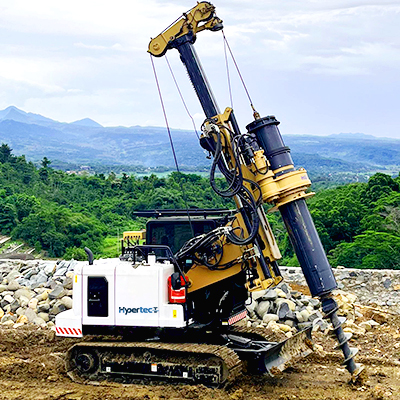
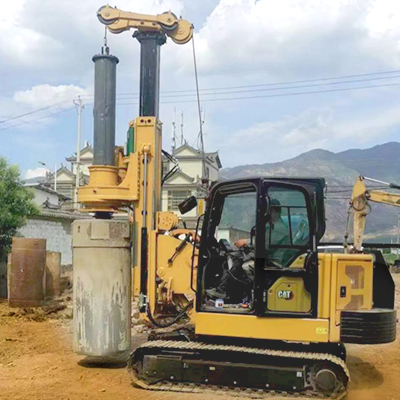
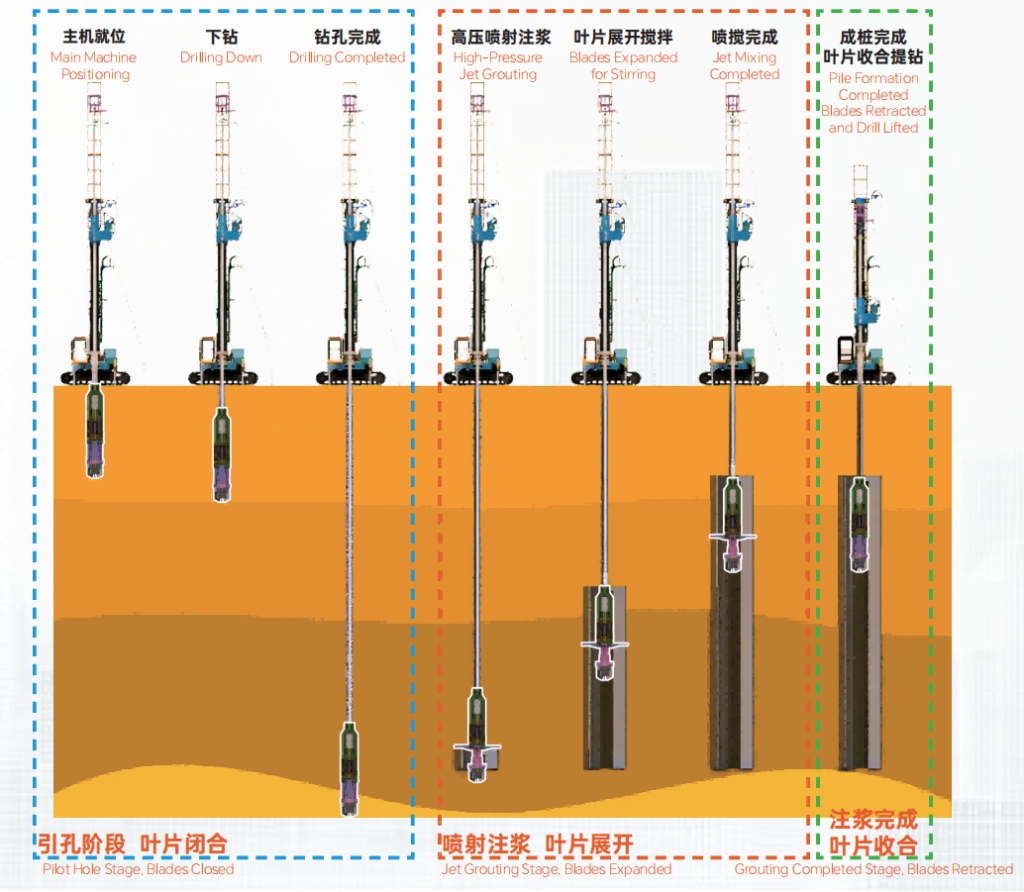
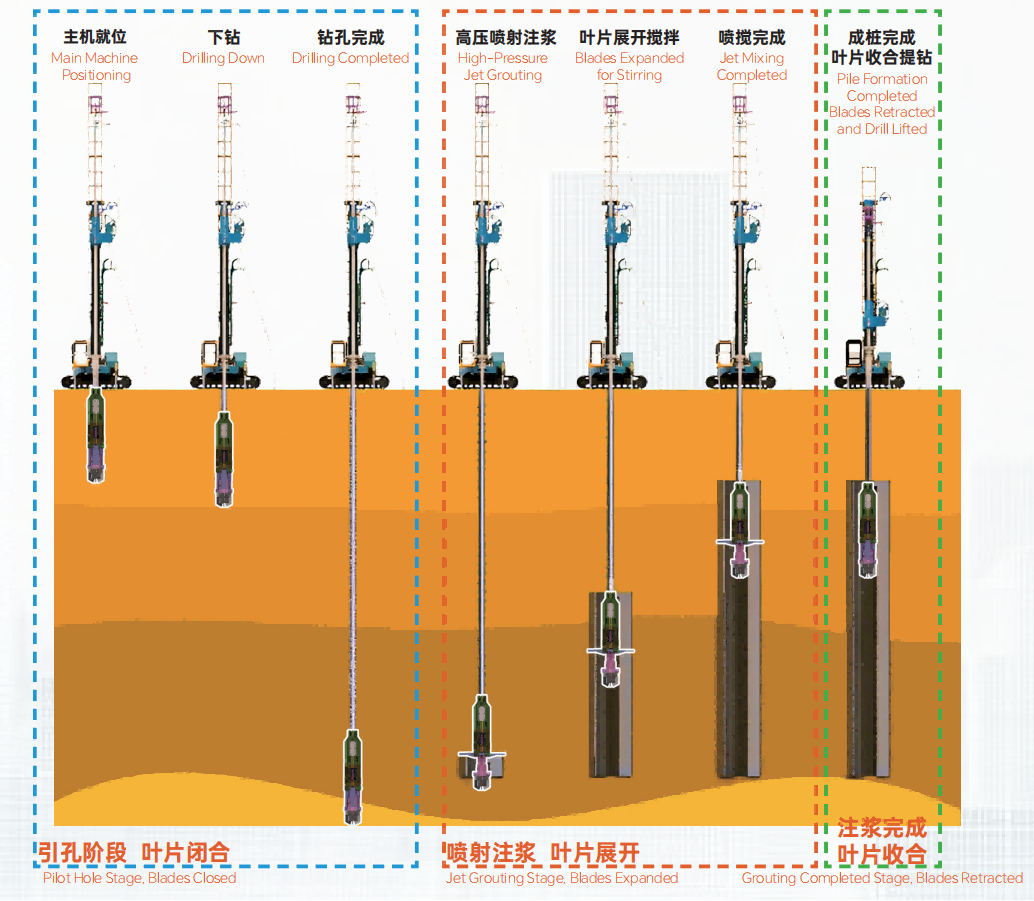
The JMP Method uses ultra-high pressure water to cut soil for hole-forming, performs secondary soil cutting with ultra-high pressure cement slurry and mixes it with exfoliated soil. It evenly mixes cement slurry and soil through active stirring by opening-closing blades at the drill bit’s front end. During drilling tool rotation, the inclined surfaces of the blades apply reverse pressure to the soil mixed with cement slurry. It monitors parameters like high-pressure water pressure/flow rate, cement slurry flow rate/pressure, blade expanded diameter, underground pressure, and verticality. It employs an underground pressure data early warning system and active slurry discharge through annular gaps in the hole, enabling omni-directional foundation reinforcement (vertical and inclined).


· Equipped with self-pilot hole function, real-time verticality monitoring, and stratum parameter collection.
· Underground pressure early warning system to control the impact of construction process on the surrounding area.
· High-pressure water wrapped in coaxial compressed air cuts the soil, expanding the free surface of soil exfoliation and ensuring more reliable pile diameter.
· Ultra-high pressure cement slurry performs secondary cutting on the soil and mixes with the exfoliated soil.
· Active stirring by the opening-closing blades at the front end of the drill bit enables more uniform mixing of cement slurry and soil, ensuring reliable pile quality.
· During the rotation of the drilling tool, the inclined surfaces of the opening-closing blades are used to apply reverse pressure to the soil mixed with cement slurry, keeping the cement slurry in the stratum.
· The cement content in the reinforced body is more uniform, with lower cement content and less waste slurry.
Construction Principle
During the Construction Preparation Phase, conduct surveying and setting out as well as trench excavation. Complete equipment positioning, commissioning, calibration and inspection, set initial parameters followed by trial pile formation, and perform jet grouting and mixing at the pile bottom.
If the trial pile formation is not smooth, revise the initial parameters and retry; if successful, confirm the automatic pile formation parameters and realize full-automatic pile formation through the digital system. Parameters are automatically monitored during the process, and the construction is finally completed. Meanwhile, the trial pile formation test will evaluate multiple aspects such as pile formation feasibility to obtain construction parameters.
Construction Case
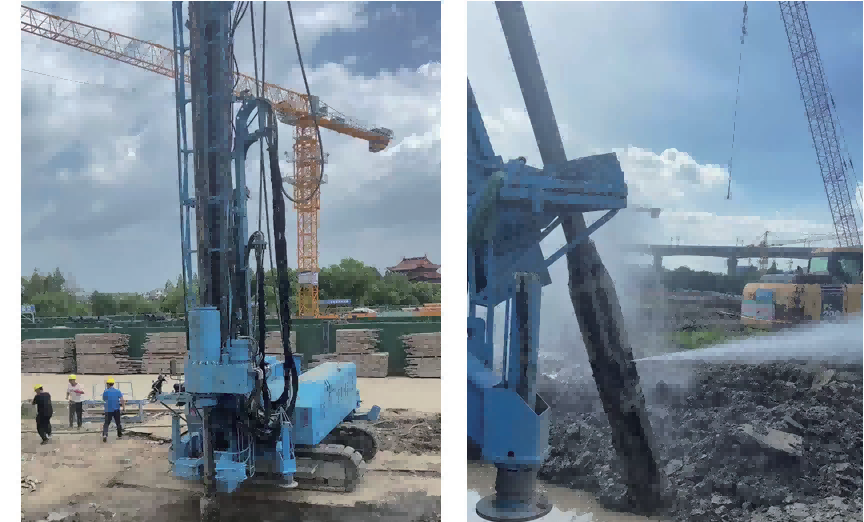
Underground Civil Engineering of the Station Yard Area of Shanghai East Railway Station in the Oriental Hub
Contracting Unit: A joint venture between Shanghai Construction Group Co., Ltd. and China Railway No.24 Engineering Bureau Group Co., Ltd. won the bid and undertook the project. As the leading unit, Shanghai Construction Group, together with China Railway No.24 Engineering Bureau, established a professional team to be responsible for the lump-sum construction contract of the underground civil engineering.
Project Period: March 25, 2023 – May 27, 2025
Project Overview: The Underground Civil Engineering of the Station Yard Area of Shanghai East Railway Station in the Oriental Hub is on a grand scale, with a foundation pit nearly 28 meters deep and an area of nearly 200,000 square meters, presenting extremely high construction difficulty. The project adopts intelligent management and control as well as Building Information Modeling (BIM) technology to overcome the construction challenges of ultra-deep foundation pits. Upon completion, it will form a world-class transportation hub, realize innovative air-rail intermodal transportation, and promote the integrated development of the Yangtze River Delta.